
How to Properly Evaluate a RAG System: the 9 Essential Metrics
The 9 essential metrics for evaluating a RAG system, on two axes (retrieval + generation) plus the human verdict — with diagrams, formulas, a troubleshooting table and how to automate them in practice.
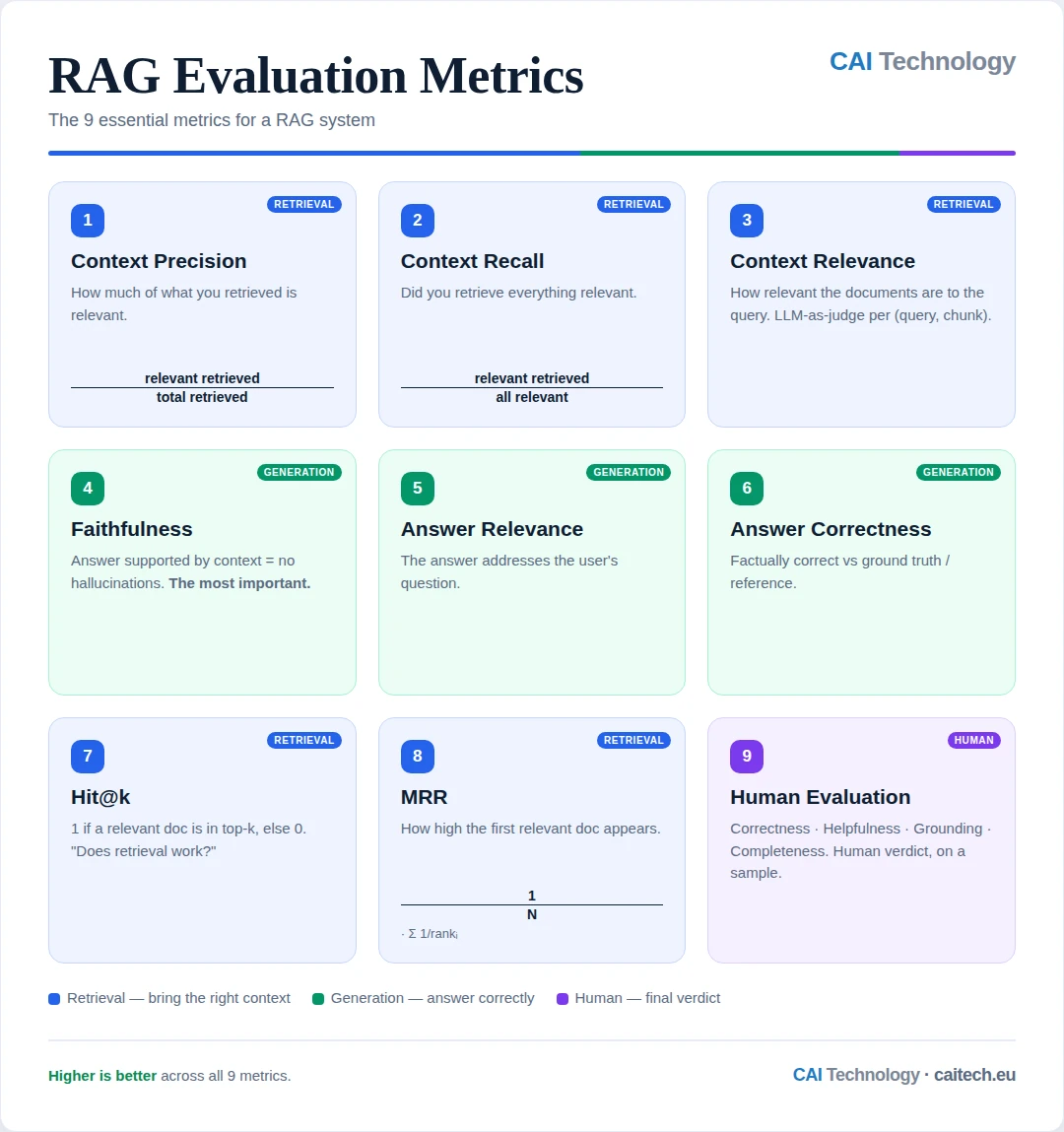
How to Properly Evaluate a RAG System: the 9 Essential Metrics
A RAG (Retrieval-Augmented Generation) system has two components that can fail independently. If the answer is poor, you need to know which part is to blame. This article summarizes the 9 essential metrics, explains them visually and shows how to implement them in practice — including how we already use them in a real system of ours.
Why you need metrics on TWO axes
The two components of a RAG:
- Retrieval — which documents/chunks it brings from the knowledge base.
- Generation — what answer the model produces from the retrieved documents.
That is why the metrics split into two families + a human one:
| Family | What it measures | Metrics |
|---|---|---|
| A. Retrieval | Quality of the retrieved context | 1. Context Precision · 2. Context Recall · 3. Context Relevance · 7. Hit@k · 8. MRR |
| B. Generation | Quality of the answer | 4. Faithfulness · 5. Answer Relevance · 6. Answer Correctness |
| C. Human | Final human judgment | 9. Human Evaluation |
Diagram 1 — Where each metric applies in the pipeline
How to read the diagram: the RETRIEVAL metrics evaluate what comes out of the retriever (before the LLM); the GENERATION metrics evaluate the final answer; Human Evaluation is the human verdict over everything.
Family A — RETRIEVAL metrics
1. Context Precision — how much of what you retrieved is relevant
Precision = relevant chunks retrieved / total chunks retrieved
- Intuition: low noise. If you retrieve 5 chunks and only 2 are relevant → precision 0.4.
- Higher = better. Low precision = the retriever brings junk that distracts the LLM.
- Fix when it’s low: add a reranker, lower
k, filter on metadata.
2. Context Recall — you retrieved EVERYTHING that was relevant
Recall = relevant chunks retrieved / all relevant chunks
- Intuition: coverage. If there were 3 relevant chunks and you retrieved only 2 → recall 0.67.
- Higher = better. Low recall = the retriever MISSES information → incomplete answer.
- Fix when it’s low: increase
k, improve embeddings/chunking, hybrid search (semantic + keyword).
Precision and Recall are in tension: raise
k→ recall ↑ but precision ↓. The reranker reconciles them (retrieve a lot, then filter to the top).
3. Context Relevance — how relevant the documents are to the question
Checks, qualitatively, whether the retrieved documents actually relate to the query. Higher = better. Implementation: LLM-as-judge gives a relevance score per (query, chunk).
7. Hit Rate (Hit@k) — at least one hit in the top-k
Hit@k = 1 if a relevant doc is in the top-k, otherwise 0.
- Intuition: binary per query. The average over the whole set = % of questions for which the retriever hit at least one good doc in the first
k. - Higher = better. A quick “is the retriever working?” metric.
8. Mean Reciprocal Rank (MRR) — how HIGH the first relevant doc appears
MRR = (1/N) · Σ (1 / rankᵢ) — where rankᵢ = the position of the first relevant document for query i, and N = the total number of queries.
- Intuition: if the first relevant doc is at position 1 → 1.0; at position 2 → 0.5; at position 5 → 0.2.
- Higher = better. Unlike Hit@k (just yes/no), MRR penalizes poor ranking.
- Fix when it’s low: reranker, better embeddings, HNSW tuning.
Family B — GENERATION metrics
4. Faithfulness — the answer is supported by the context (no hallucinations)
Checks whether every claim in the answer is covered by the retrieved context. “No hallucinations.” Higher = better.
- The most important anti-hallucination metric. Low faithfulness = the model is making things up.
- Implementation: LLM-as-judge (compare answer vs context) OR grounding via embeddings (cosine answer↔source span).
5. Answer Relevance — the answer addresses the user’s question
An answer can be 100% faithful to the context yet off topic. It measures how well it answers what the user actually asked. Higher = better. Fix when it’s low: improve the generation prompt, reformulate the query.
6. Answer Correctness — factual correctness against the reference truth
Compares the answer with a ground truth / reference. Higher = better. Requires a “gold” set of correct answers. Implementation: LLM-as-judge or semantic matching vs the reference.
Family C — Human Evaluation
9. Human Evaluation — human judgment
Human judgment of usefulness, accuracy and grounding, on a rubric:
- Correctness (factually correct)
- Helpfulness (useful to the user)
- Grounding (anchored in sources)
- Completeness (complete)
It remains the gold standard for ambiguous cases; it is done on a sample, not on everything.
Diagram 2 — Taxonomy of the 9 metrics
How to implement them in practice
| Metric | How you compute it | What you need |
|---|---|---|
| Context Precision / Recall | Compare the retrieved chunks with a “gold” set of relevant chunks | Annotated set (query → relevant chunks) |
| Hit@k / MRR | Directly from the retriever’s results + gold set | Gold set + the returned positions |
| Context Relevance | LLM-as-judge on (query, chunk) | A judge LLM |
| Faithfulness | LLM-as-judge (answer vs context) or grounding via embeddings | Judge LLM / embedder |
| Answer Relevance | LLM-as-judge (answer vs question) | Judge LLM |
| Answer Correctness | LLM-as-judge (answer vs reference) | “Gold” set of answers |
| Human Evaluation | Rubric + human evaluators | People + a scoring guide |
Tools: the ragas library (Python) covers Context Precision/Recall, Faithfulness, Answer Relevance, Answer Correctness (LLM-as-judge) out of the box. The pure ranking metrics (Hit@k, MRR) you compute with simple code over the retriever’s results.
How WE do it (real implementation)
Our RAG pipeline automates exactly 2 of the 9 metrics as a quality gate, at scale:
- Retrieval: vector DB (Qdrant) + embeddings (BGE-M3) + reranker → on a gold set we measure Hit@k, MRR, Context Precision/Recall. The reranker is precisely the fix for low Context Precision + MRR.
- Faithfulness (metric 4): for each question/answer pair, we compute cosine similarity ≥ 0.85 between the answer and the source span → automatic grounding = “No hallucinations”.
- Answer Correctness (metric 6): an LLM-as-judge (score ≥ 9 out of 10) verifies factual correctness against the source; the final certification is given by a stronger judge.
In practice, the “platinum dataset” is built by passing each example through automated Faithfulness + Answer Correctness — two of the metrics above, applied to hundreds of thousands of pairs.
Rough thresholds + what to do when a metric is low
| Symptom | Low metric | Probable cause | What you do |
|---|---|---|---|
| Incomplete answer | Context Recall | The retriever misses info | ↑ k, better embeddings/chunking, hybrid search |
| Answer diluted with noise | Context Precision | Too much junk retrieved | Reranker, ↓ k, metadata filters |
| Model makes things up | Faithfulness | Weak prompt / no grounding | ”Answer ONLY from the context”, grounding gate |
| Answers off topic | Answer Relevance | Weak generation/prompt | Improve the prompt, reformulate the query |
| The good doc appears late | MRR / Hit@k | Poor ranking | Reranker, embeddings, HNSW tuning |
Key takeaways
- You evaluate RAG on retrieval (do you bring the right thing?) and generation (do you answer correctly from what you brought?).
- Recall = you don’t miss; Precision = you don’t bring junk; MRR/Hit@k = good ranking.
- Faithfulness = no hallucinations (the most important); Answer Relevance/Correctness = on-topic and correct answer.
- Human Evaluation = the final verdict on a sample.
- In production, you automate Faithfulness + Correctness with LLM-as-judge / grounding and run them on thousands of examples.