
RAG vs fine-tuning in 2026: a decision matrix with real costs
When RAG (large changing corpus, citation needed) and when fine-tuning (style consistency, low latency, narrow specific task). Real 2026 numbers.
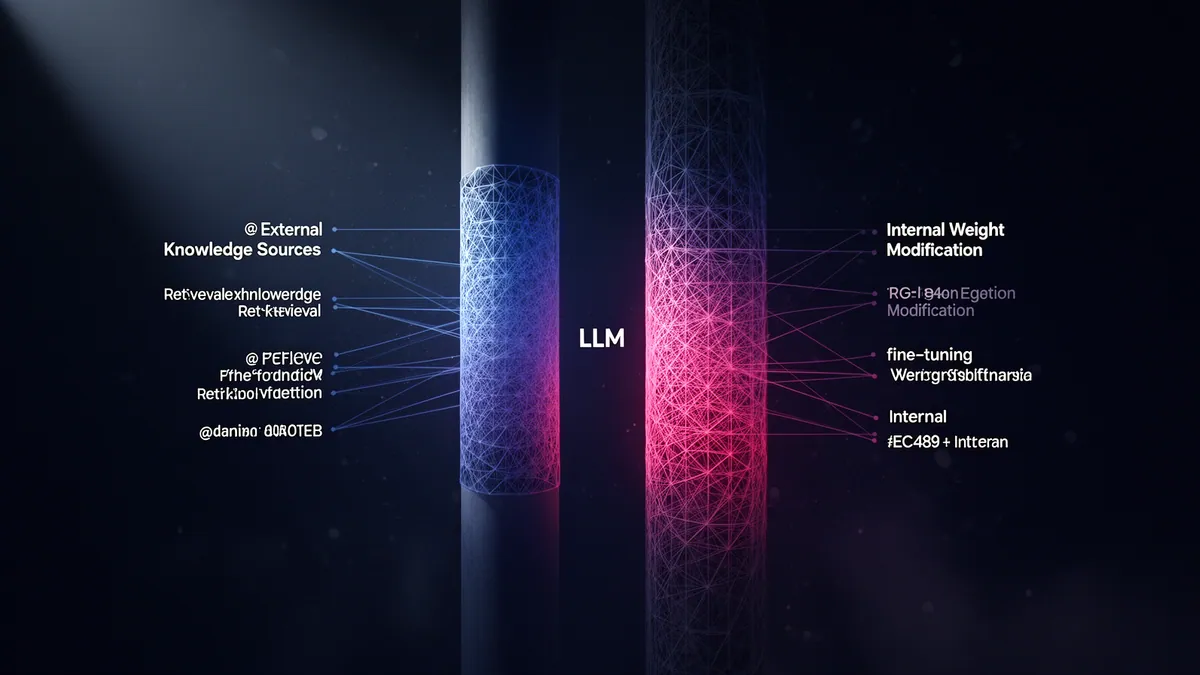
RAG vs fine-tuning in 2026: when to choose which, with real numbers
In 2024, the “RAG vs fine-tuning” debate was still confused. In 2026, with much more capable base models and significantly reduced fine-tuning costs, the decision is clearer — but not trivial. For every AI project involving “proprietary knowledge” (internal documents, proprietary databases, company jargon), the decision between RAG, fine-tuning or a combination determines architecture, cost and performance characteristics.
This article presents a practical decision matrix, with real numbers collected in 2026 projects.
TL;DR
- RAG is the choice for: large corpus, frequently changing content, source-citation requirement, transparency.
- Fine-tuning is the choice for: strict style consistency, low per-request latency, narrow well-defined task, structured output format.
- The “fine-tuned base model plus RAG” combination is rarely useful; most projects go with one or the other.
- Fine-tuning cost dropped significantly in 2025-2026 (LoRA, QLoRA, providers with accessible pricing); RAG cost (vector DB, embeddings, retrieval) is predictable and scalable.
- The most common mistake: premature fine-tuning on a small corpus. RAG works first try, fine-tuning requires iterations.
Four questions that decide
Before the matrix, four questions that eliminate 80% of ambiguity:
Question 1: does your corpus change? If yes (daily, weekly), RAG. If not (monthly/yearly or never), both RAG and fine-tuning are options.
Question 2: do you need citation? If the user must verify the source of an answer (“comes from clause X of document Y”), RAG. Fine-tuning erases the source trail.
Question 3: is the task narrow (one output format, fixed vocabulary) or broad? Narrow tasks lean toward fine-tuning. Broad tasks lean toward RAG.
Question 4: do you have a strict latency budget (under 500ms per request)? If yes, RAG with slow retrieval is problematic. Fine-tuning + cache is better.
When it is RAG (Retrieval-Augmented Generation)
RAG combines a general base model with a retrieval system that injects context-relevant fragments from the corpus at request time.
Cases where RAG wins:
- Changing technical documentation. A support chatbot answering from documentation: documentation updates weekly. RAG updates the corpus, no retraining needed.
- Legal knowledge base. Citation is mandatory. The user must verify article, paragraph. See the previous article on anti-hallucination.
- Internal assistant navigating contracts/procedures. Large volume (thousands of documents), changing, high precision required.
- Semantic search over products. E-commerce or catalog with thousands of products with natural-text descriptions.
Architectural components:
- Embedding model (turns text into a numeric vector)
- Vector database (stores vectors and enables similar-search)
- Retrieval logic (top-K, re-ranking, filtering)
- Prompt template (how results are injected into the prompt)
- Evaluation suite (how we measure that responses are correct)
Typical 2026 costs:
- Embedding model: 0.02-0.10 USD per 1M tokens (cloud), zero with self-hosted
- Vector DB: open-source (Qdrant, Weaviate, pgvector) with hosting cost, or managed at 50-500 USD/month for medium workload
- Base model inference: variable cost per request; RAG can add 1k-10k context tokens per request
- Initial work: 5-15 days for a production-ready RAG system, plus 2-4 days for evaluation
When it is fine-tuning
Fine-tuning adjusts a base model’s parameters on a specific dataset. In 2026, the most common methods are LoRA and QLoRA, which do not modify all parameters but only a subset, reducing cost and preserving the base.
Cases where fine-tuning wins:
- Style consistency in output. Generating text in a specific brand style (tone of voice, email formats, templates), where the base model is too variable.
- Structured output format. The model must consistently produce output in a specific JSON format, without variations. Fine-tuning on examples aligns it.
- Narrow task, large volume. Automatic classification of support tickets into 20 categories. The base model works with prompt engineering, but fine-tuning increases accuracy by a few percent and reduces per-inference cost.
- Strict latency. Smaller fine-tuned models can match large-model quality on a narrow task with much lower latency.
Architectural components:
- Training dataset (input → desired output), typically 500-5000 examples
- Fine-tuning pipeline (LoRA/QLoRA, with minor hyperparameter search)
- Separate eval set (200-500 examples) to measure improvement
- Re-training strategy (when do we redo fine-tuning?)
- Deployment of the fine-tuned model
Typical 2026 costs:
- LoRA fine-tuning on a medium open-source model: 50-500 USD per run (cloud GPU)
- Fine-tuning on API providers (OpenAI, Anthropic via partners): 5-50 USD per 1M data tokens
- Initial work: 7-20 days for data curation + training + eval + deployment
- Post-deployment inference cost: similar or lower than the base model
Costs dropped dramatically since 2024. Fine-tuning is no longer prohibitive.
Decision matrix
| Characteristic | RAG | Fine-tuning |
|---|---|---|
| Large corpus (1M+ documents) | Yes | No |
| Corpus changes frequently | Yes | No |
| Citation mandatory | Yes | No |
| Strict output format | No | Yes |
| Style consistency required | No | Yes |
| Latency < 500ms per request | Hard | Yes |
| Large daily volume (1M+ inferences) | Costly | Yes |
| Narrow task with clear pattern | Possible | Yes |
| Broad, open-ended task | Yes | No |
| Small initial budget (under 5k EUR) | Yes | Possible |
| Team without in-house ML | Easier | Hard |
The RAG + fine-tuning combination
There are cases where the combination works:
- Fine-tuning the base model to parse / format output
- RAG to bring factual content
Example: a legal assistant fine-tuned on the firm’s citation style, plus RAG over a case-law corpus. The fine-tuned model knows how to cite correctly; RAG brings the factual data.
Caution: this combination doubles complexity. We recommend it only if both problems are clear and separate. For most projects, one of the two is enough.
Common mistakes
Mistake 1: premature fine-tuning on 50 examples. Effective fine-tuning requires hundreds to thousands of good examples. Below that threshold, prompt engineering plus RAG outperforms fine-tuning.
Mistake 2: RAG without re-ranking. Top-K vector search produces candidates, but they are not always the most relevant. Re-ranking with a small model (cross-encoder) on top-50 → top-5 greatly improves quality.
Mistake 3: wrong chunk size for RAG. Chunks too large dilute the semantic signal; too small loses context. Typical threshold: 200-500 tokens per chunk with 10-20% overlap.
Mistake 4: lack of evaluation. Both RAG and fine-tuning must be tested on a fixed set of queries with expected answers. Without that, you do not know whether parameter changes improve or break things.
Mistake 5: fine-tuning as the solution to hallucination. Fine-tuning does not solve hallucination. If the model does not know a fact, fine-tuning without data about that fact does not teach it reliably. RAG with forced citation is the correct solution for factual requirements.
How we decide with a client
Our standard process within a Discovery Sprint:
- Initial questions. The four above.
- Data audit. How much corpus do you have? In what state? How often does it change? Do you have a history of real queries?
- Fast prototyping. A simple RAG (based on pgvector + an OpenAI/Claude model) in 2-3 days, with measurement on 30-50 real queries.
- Decision. If simple RAG resolves over 80% of cases, we go with RAG plus improvements (re-ranking, chunk strategy). If not, we evaluate fine-tuning or a combination.
In 80% of 2025-2026 projects, RAG won. The remaining 20% are tasks with strict formats (extraction, classification) where fine-tuning produced notably better results.
Conclusion
The RAG vs fine-tuning decision in 2026 is not religious. It is a technical decision with clear criteria: changing? citation? strict format? volume? Answer four questions and 80% of the time you have the right direction. For the rest, fast prototyping shortens deliberation.
For both options, observability and continuous evaluation are mandatory. A RAG system or a fine-tuned model that is not measured degrades silently.
Related articles
- Anti-hallucination for legal chatbots
- Pillar RAG — retrieval-augmented generation systems
- Pillar Consulting — AI assessment
- Pillar IRIS — the CAI Technology orchestrator agent
External sources
- “Retrieval-Augmented Generation for Knowledge-Intensive NLP Tasks” — Lewis et al., arXiv 2005.11401 — the seminal RAG paper
- “LoRA: Low-Rank Adaptation of Large Language Models” — Hu et al., arXiv 2106.09685 — the foundation of efficient fine-tuning
- “QLoRA: Efficient Finetuning of Quantized LLMs” — Dettmers et al., arXiv 2305.14314 — low-memory fine-tuning
- Anthropic — fine-tuning guidance — recent official reference
- OpenAI — fine-tuning guide — official reference for the standard pipeline
- Pinecone — RAG best practices — industry guide for chunk size, retrieval, re-ranking
Next step
If your team is evaluating RAG or fine-tuning for a specific case, we offer a 30-minute technical consultation at no cost to decide the direction.